Wednesday, 24 February 2016
UNIT 7 Action Painting
Action Painting is form of painting where you throw, splash or pour paint towards your canvas creating an abstract style painting, Jackson Pollock a famous abstract impressionist artist practised action painting within many of his works causing the process to gain popularity. For example, this is a painting by Pollock 'Blue Poles' 1952, you can clearly see how the paint is applied by the random splatters of paint.
To include action painting into my Unit 7 work I took a video from underneath a sheet of plastic on which I created an action painting showing another form of time based media. Here is a link to the video of my Pollock inspired action painting:
https://www.youtube.com/watch?v=YEBjybbwj34
A video of an action painting can give away hints towards the emotions explored within the artwork: You can watch to see if the flicks of the paintbrush are aggressive or relaxed, or perhaps to see if the movements of the paintbrush are fluid or jerky. By watching the artist work you can see the movements which can give a huge insight to the overall emotions reflected within a painting. For example, in my action painting I remember feeling frustrated at the time which is reflected in my movements as they seem to be quite aggressive, jerky and rushed.
UNIT 7 Reportage Drawing
Reportage drawings are really quick drawings of what you can see in front of you, this form of time based media is a more traditional method as it just uses paper and pen (or any other media you may use at the time) rather than using any technology or optical illusions. The purpose of reportage drawing is for you to record whatever you are looking at for example if I were to catch a bus I may produce several drawings of my view from the window at certain intervals during the journey however I would have to look once and draw it quickly from memory as the bus is constantly moving. For this workshop we were asked to complete several tasks that were slightly different to create a series of reportage drawings.

For the first task we were asked to do thirty second drawings of each other, we could either draw full portraits or just focus on certain aspects. I found this task incredibly hard as I am used to taking my time therefore throughout the five drawings for this task you can see I started off big and barely completed an outline therefore I began drawing smaller so I would have more time for details however towards the end I gained more confidence as I became accustomed to drawing quickly and

drew the last couple sketches a little bigger. For this tasked used pen as it is a media I am comfortable and confident working in.

For the second task we were asked to complete five continuous line drawings of the objects around us, each drawing was thirty seconds and we had to use different media when possible. I used pencil to draw an empty cola bottle, blue felt tip to draw a box of pencils, pen to draw my phone and a green fine liner to draw the hair of one of my classmates. I found this task easier as I built up my confidence in the first task therefore my drawings were fairly sized and I managed to complete all five drawings. Although I found it easier and quicker to do continuous line drawings.
For the third task we were asked to choose an object on the table then draw it five times however each time you must turn your page and use a different colour. Each drawing is to be completed within forty seconds. I choose to draw a goats skull and I drew it rather large so that I would fill the page by then end of it, I found this task the easiest because not only was I confident with drawings quickly on a larger scale but I found an easy way to draw the object on the first turn so that the rest of the drawings would be simpler and look identical to one another to some extent.
In my own opinion, reportage drawing isn't something I would do again simply because my style of artwork is more detailed, something that has a lot of time put into it whereas reportage drawing is fast paced, therefore this is a weakness for me. However, reportage drawing is very effective in completing its purpose therefore if I were in a situation where it is needed I would happily oblige to making a thirty second sketch otherwise I would leave reportage drawing to those who are more suited to a fast paced style of work.
UNIT 7 Thaumotrope
In this workshop we focused on the thaumotrope: an optical toy that has an image on both sides which appear to join and create one image when it is turned rapidly. We were shown some examples of thaumotropes first for us to fully understand the toy, a famous example of the thaumotrope is in the Sleepy Hollow film which you can see in the following link: https://www.youtube.com/watch?v=ttjKbchiDXs
The first thaumotrope I made was a template provided by Kat, who managed the workshop, therefore the making was extremely simple. I had two discs with the images on that I stuck together making sure the second disc was upside down to ensure the thaumotrope would work, after I created the hole and tied elastic bands to each side.
Here is a link to the video of my working thaumotrope:
https://www.youtube.com/watch?v=83aw65OjNZI
I then continued to creating my own thaumotrope, this time instead of using to discs I drew the two images on both sides of the same piece of card therefore I had to use a light box so I could position the second image in the right place to ensure my design would work.
When making my own thaumotropes I decided to use different shapes to see if the shape of card would affect the animation, both my diamond and square thaumotropes worked successfully therefore the shape of card doesn't affect the animation.
Here is the link to the video of my working kite thaumotrope:
https://www.youtube.com/watch?v=zP2vMJ6Rku4
Here is a link to the video of my working balloon thaumotrope:
https://www.youtube.com/watch?v=6FZ6DThgo24
Thaumotropes are a very basic form of time based media however the simplicity does not lessen the effectiveness of the process. The simplicity truly shows the creativity behind inventing this optical illusion and the slightly blurry result shows how old this method is, due to this method being preserved for so long gives me hope that we can continue to preserve time based art into the future. I think that thaumotropes can be cleverly created to have deeper meaning than just an optical illusion for example in the clip of sleepy hollows that I showed earlier in my blog showed a caged bird. However as a single image the bird is flying free perhaps, as a quick interpretation, the repetitive action of spinning could represent the ever ticking clock and the bird represents ourselves and all living things showing that we are trapped by time as the bird is trapped by the cage.
UNIT 7 Zoetrope: History of
![]() |
| William Horner |
The zoetrope was invented by William Horner an English Mathematician in 1834, he originally named his invention the Daedalum or otherwise known as the 'wheel of the devil'. The design was based on Plateaus phenokistoscope and became more popular due the fact it was more convenient and more than one person could view the animation at one time.
In 1868 a Scottish physicist name James Clerk Maxwell improved Horners zoetrope by using concave slits which would reduce distortion when viewing the animation.
Eventually in 1887 William F. Lincoln patented the name of "Zoetrope", giving the optical toy the name it uses today.
In the modern day the zoetrope continues to be developed through the work of several artists. An example of a modern version of the zoetrope is a series of three dimensional shapes placed upon a rotating turntable in a chronological order. The use of strobe lighting prevents blurriness.
Here is a link to a video example of the original zoetrope:
https://www.youtube.com/watch?v=7k3a9HyhqPc
Here is a link to a video example of a modern version of the zoetrope:
https://www.youtube.com/watch?v=RjSxrVXsfVM
UNIT 7 Zoetrope Animation
A zoetrope is a 19th century optical toy consisting of a cylindrical shape that has a series of images on the inner side that when viewed through the slits along the side of the cylindrical shape it creates the illusion of continuous motion.
During my visit to the Animotion exhibition at The Civic there was a work station in which you could create your own zoetrope animation by tracing the series of images onto a strip of paper, once drawn you would place the strip of paper on the inner side of the rotating drum, By looking through the slits whilst the cylinder is spinning you can watch your drawings come to life.
Below are some images that the 20-21 visual arts centre posted to promote the exhibition, they show some people making their own series of images to view in the zoetrope.
When I visited I decided to create one myself following the instructions at the work bench, as I was limited for time I did trace the cartoons provided however I believe if I were to create another the cartoon would have been fairly simple to
create a zoetrope strip that would have flowed fluidly without a lot of jerkiness. Overall, the whole process is relatively easy providing that you draw each image in the correct place to recreate the fluidity of continuous motion.
Here is link to the video of the zoetrope I created at the exhibition:
https://www.youtube.com/watch?v=FeGIXxtr4Dg
UNIT 7 Artist research: Bill Viola
Bill Viola graduated from Syracuse University with a Bachelors in Fine Art. He then went on to work as a technical director in Italy before travelling across the Solomon Islands, Java, Bali and Japan to study and record traditional performing arts. In 1977 cultural arts director Kira Perov invited Viola to show his videotapes at La Trope University; a year later the pair married and began working and travelling together.
Bill Viola is internationally recognised as one of the leading artist in time based media, his work explores the phenomenon of sense perception and focuses on universal human experiences such as: Birth , Death and aspects of conciousness. Viola uses videotapes and architectural video installations to create a total environment of video and sound that immerses the viewer in image and sound.
In my opinion, Violas video work seems extremely simple but by seeming simple it allows the viewer to pay more attention to what is happening and to think "Why?", this way it truly allows the viewer to think about the story and the embedded meaning by themselves without his work blatantly stating the reasoning. Its beautifully minimalistic: one person, the four elements and a silent story.
Below is a link to a full video of Bill Viola's 'Ascension' 2000:
https://www.youtube.com/watch?v=2C66IBBpWYs
UNIT 7 Animotion exhibition at The Civic
| Calavera Spacecadets air design |
| The Nature of Imagination David Urwin |
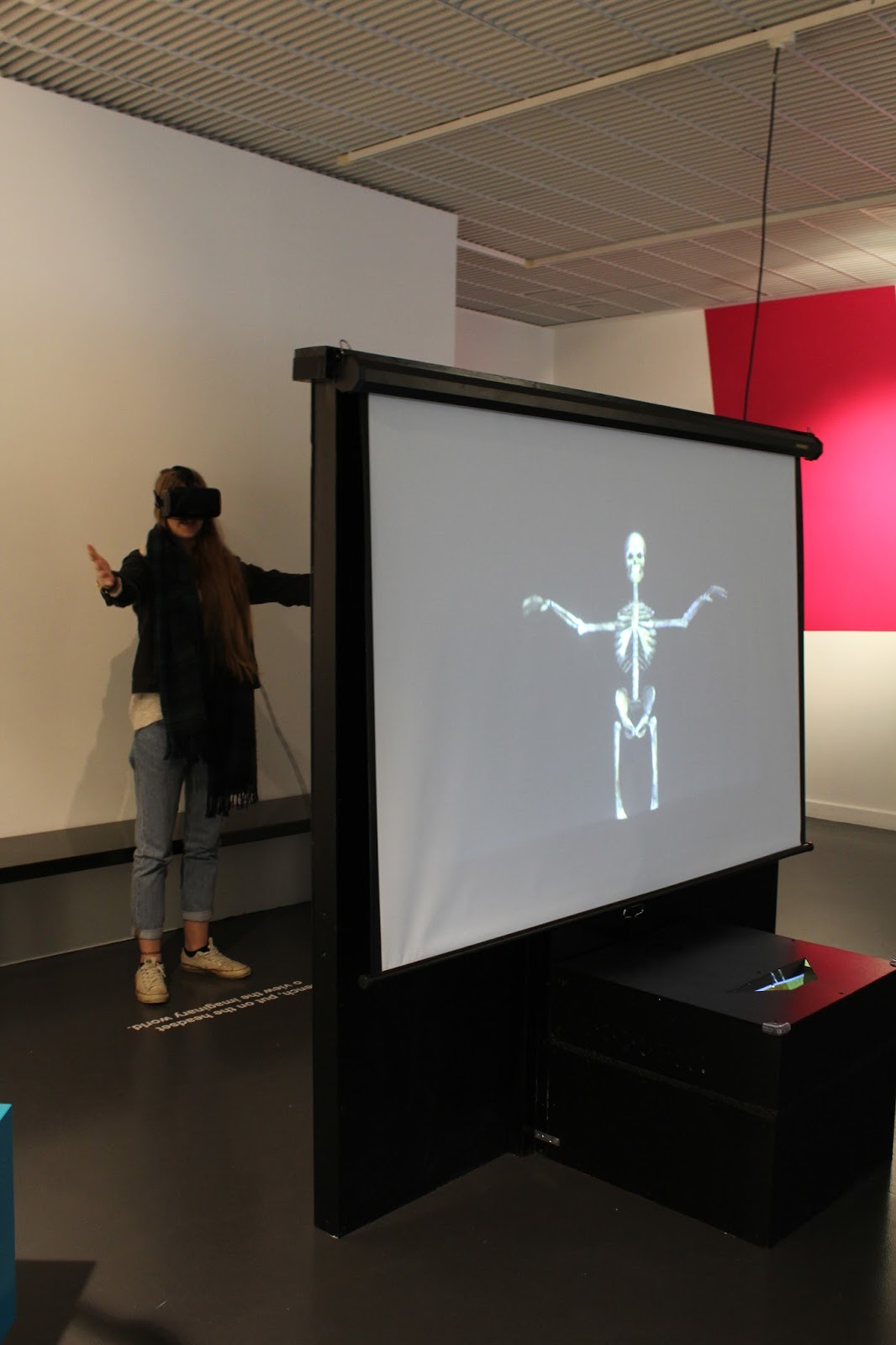
My favourite piece at the exhibition was the "SYNCHRONIcITY" interactive table created by Michele Panegrossi and AYE AYE Interactive Experiences at the beginning of 2016; the processes used to bring the table to life is stop motion animation and projection mapping. The artwork doesn't change from different angles except the 3D aspects of the table from a horizontal angle however when your hand hovers over the table the appearance of the area below your hand changes. This type of time based media will be hard to preserve since the work uses certain software's however if copies of his work and the software were made and kept safe then the artwork can be projected onto the table once more in the future. If I could talk to the artist I would as him what inspired him to begin the creative process of creating this artwork, by asking him this we may be given an insight into perhaps an alternative interpretation of the work. The reasons why this piece was my favourite was because not only was it interactive but the reactions to our movements are varied making it interesting and the process of how it works is a lot more complex than other exhibits.
Interactive, Intriguing, Modern, Unusual, Magical.
Here is a link to a video of the exhibit when interacted with:
https://www.youtube.com/watch?v=e4wpyb_7lgY
Subscribe to:
Posts (Atom)